

After the donation bin 👚
a visit to the facility where our unwanted clothes really go

Some things you have to experience to fully understand.
We hear about textile waste, we see overwhelming piles of clothing, but to actually visit a facility where they sort this textile waste on a daily basis? It's a whole new lens.
Last week, as part of a sustainable fashion conference I attended we got to visit one of these textile sorting facilities. The kind where the clothes that don't get resold at vintage boutiques go.
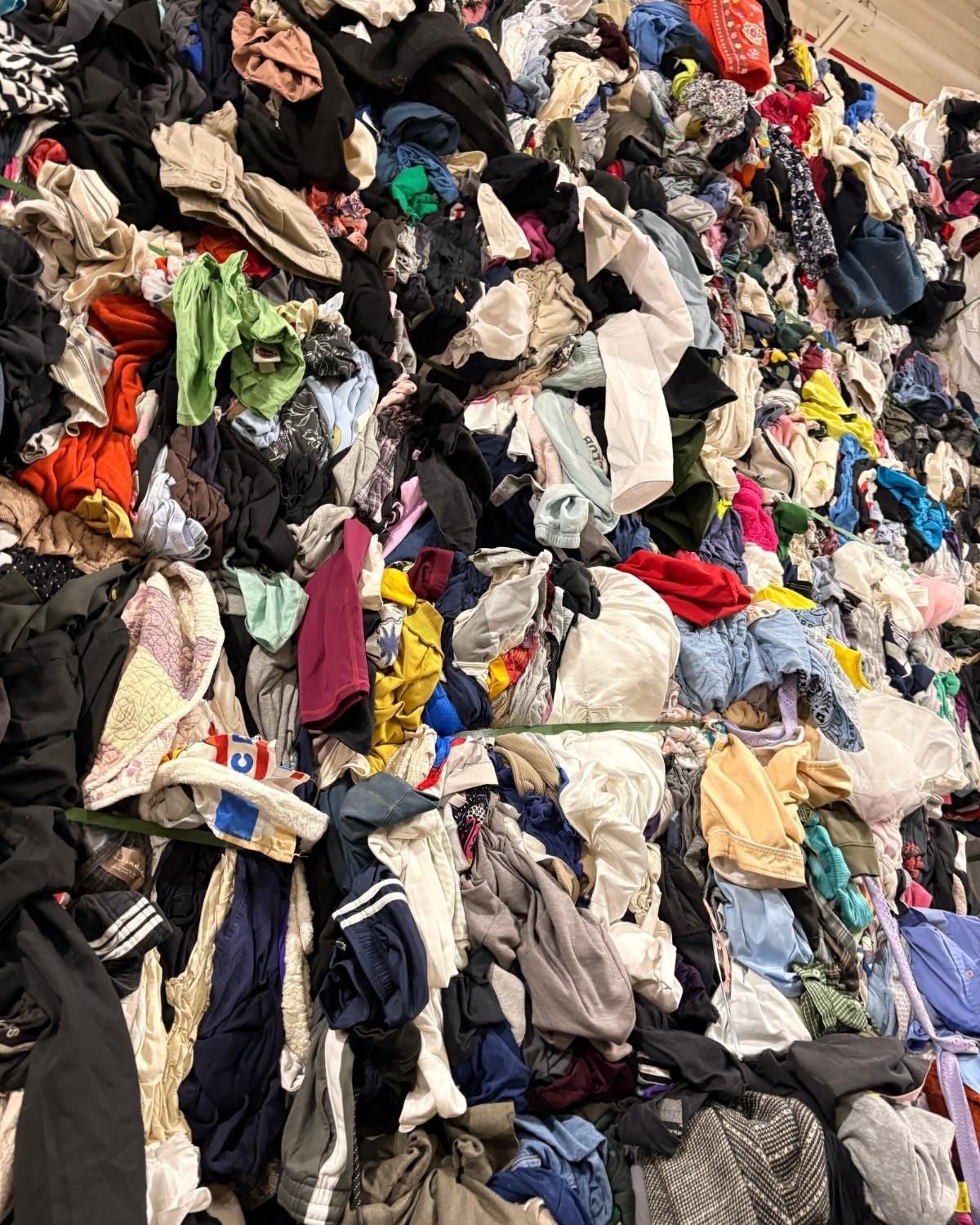
As you might imagine: that's a lot of clothing.
In every color, every pattern, every makeup of fibers imaginable. All collected together in an indistinguishable stream of fabric.
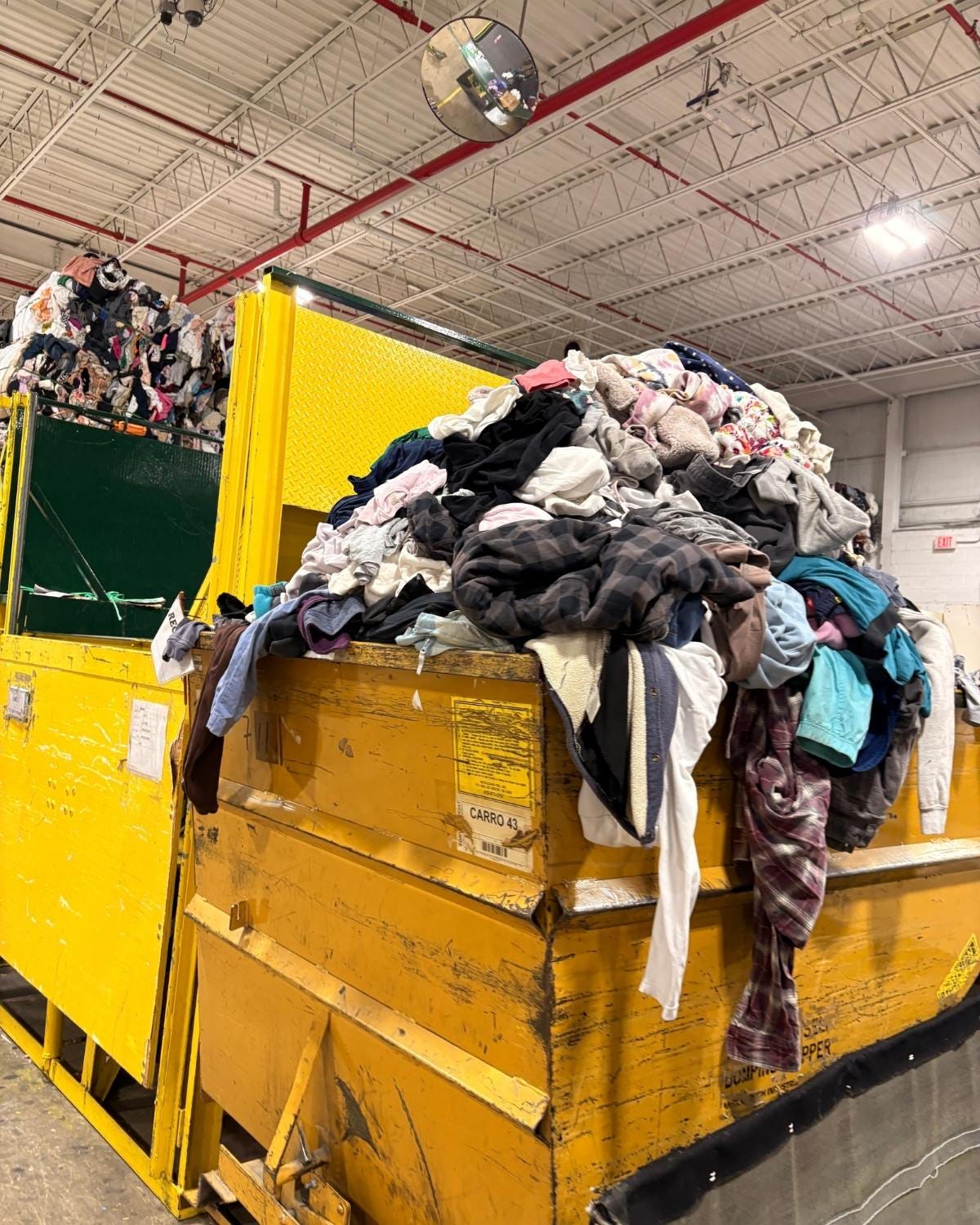
This facility is state-of-the-art when it comes to textiles sorting.
Conveyer belts shift tons of clothing from trucks into the facility. Humans sort textiles with the help of tech that scans textiles quickly for fiber content.
Machines whiz by to dump presorted textiles into their appropriate bins before those bins get baled and moved with forklifts.
It's a system built by Return to Vendor — a company creating mono-material garments from regenerated nylon that can be 100% recyclable.
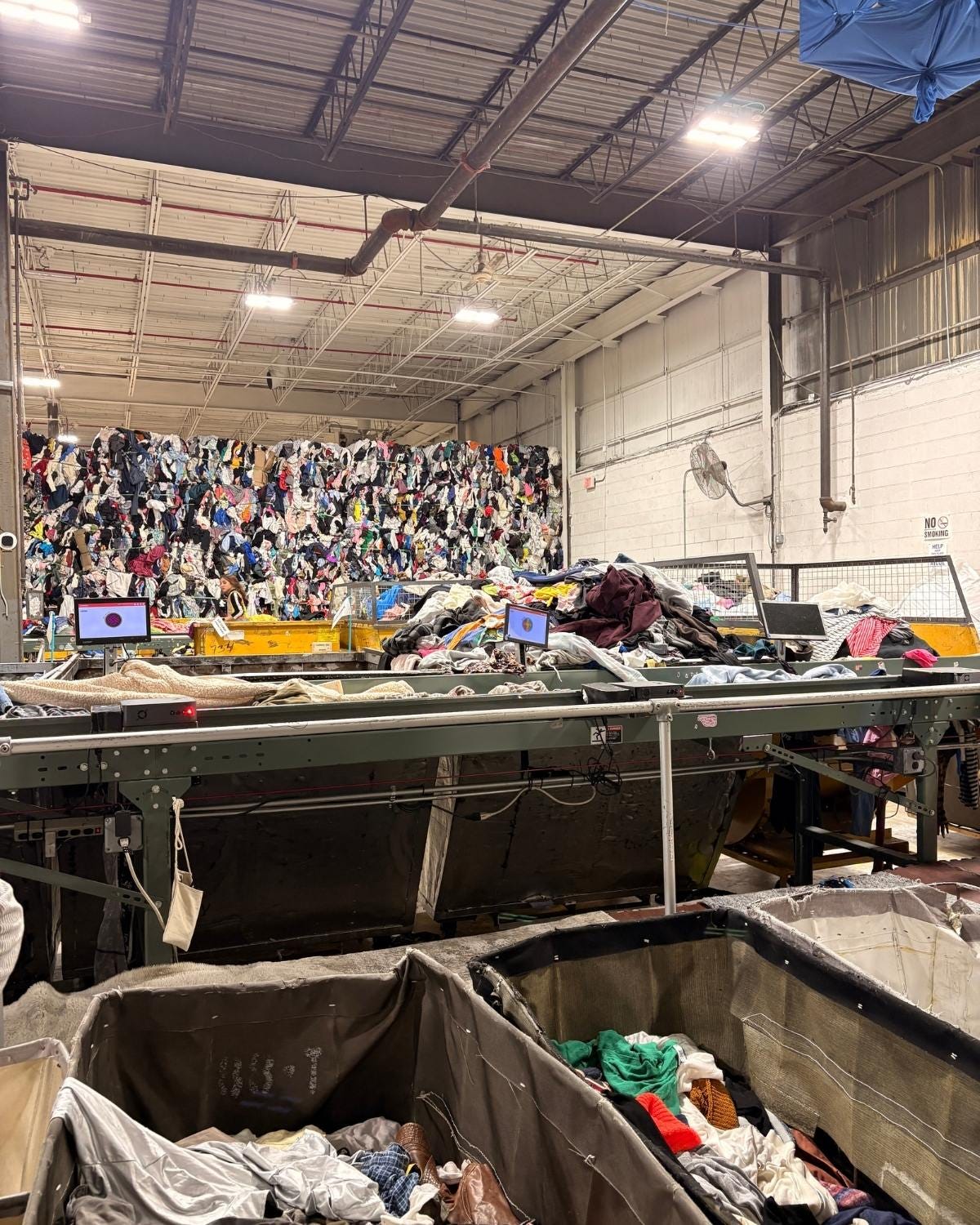
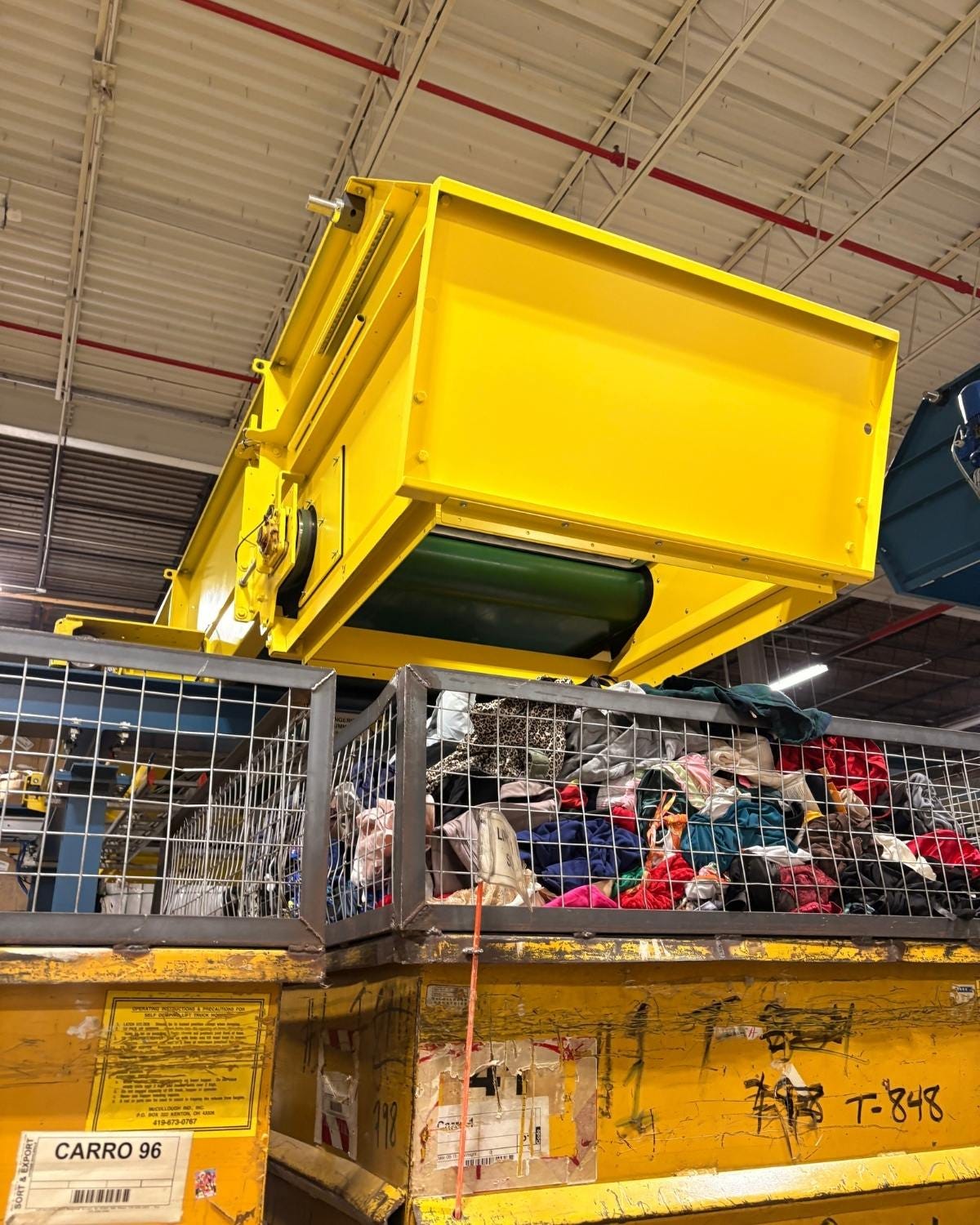
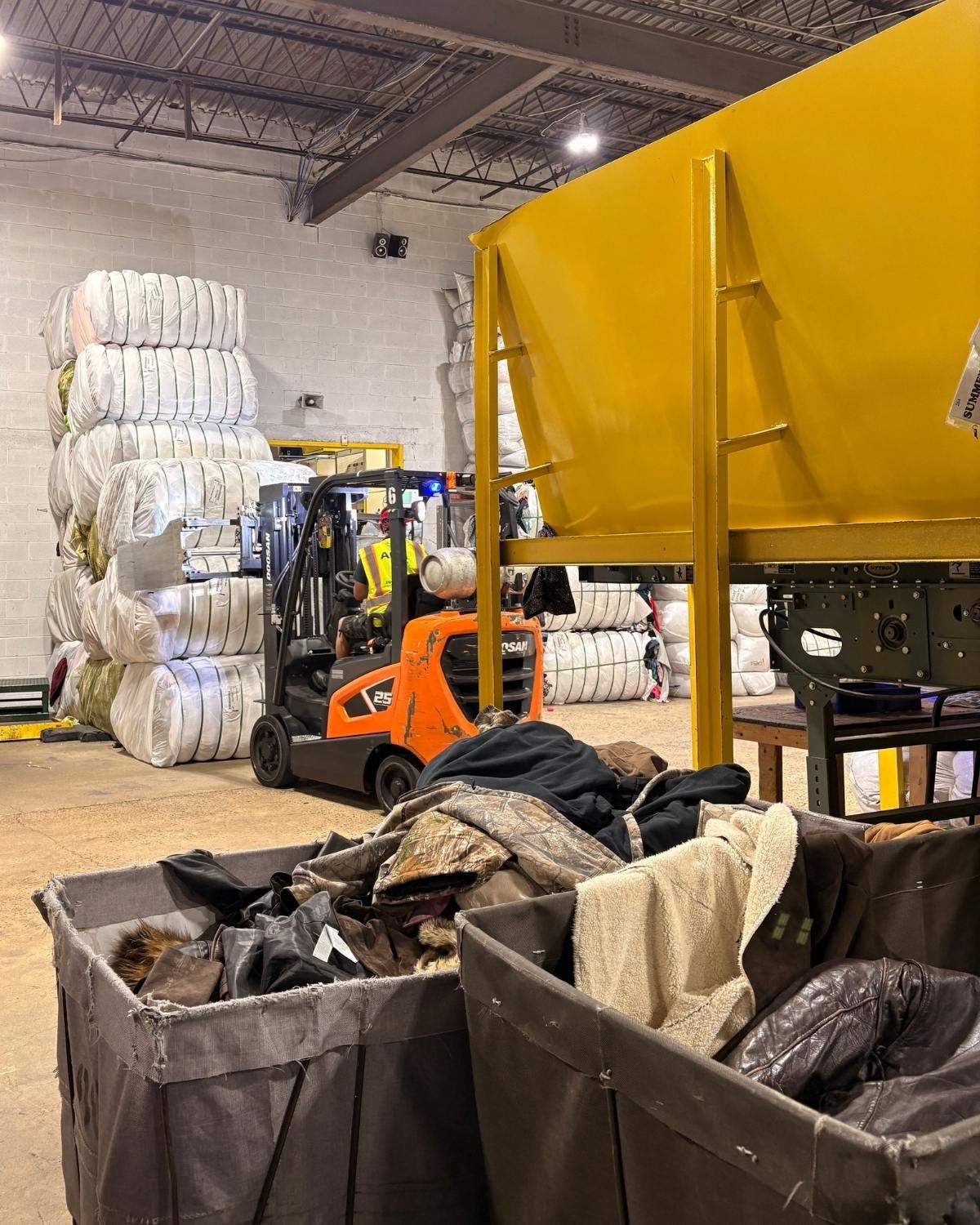
It's both impressive and overwhemling.
As relatively advanced as the sorting process has gotten, the best-case end-of-life scenario for most of the garments made today is carpet padding. (Better than the fate of our footwear at least. True shoe recycling is nonexistent.)
The whole vision of Return to Vendor stemmed from these challenges: they saw that garments faced real barriers to actually getting recycled into new garments — so they wanted to design for circularity from the beginning.
There are a number of textile-to-textile recycling companies working to change the fate of our old clothes. While the Ellen MacArthur Foundation says only 1% are actually recycled into fibers, Fashion For Good reports that 56% of textiles in the waste stream in the US could be suitable for fiber-to-fiber recycling.
Whether textile-to-textile recycling can scale depends on a few things moving in the right direction at once. The infrastructure needs to exist, individuals need to participate, and the economics need to work. Regulation is moving relatively quickly, though France's recent textile collection challenges show that end-of-life laws without infrastructure capacity or import restrictions on new fast fashion to back them up have serious limitations.
Coupled with the fact that the U.S. rate of plastic recycling has declined to just 5% fifty years after plastic recycling was established in the country, I'm not as idealistic as some about the numbers textile-to-textile recycling will be able to achieve.
So as I was walking through the facility, I couldn't help but wonder (read in my best Carrie Bradshaw voice) if we saw those trendy pieces strewn across a facility tossed around like worthless rags, instead of worn on that influencer against the backdrop of a perfectly curated beach vacation:
How much would our consumption habits change?
Not out of guilt — shaming isn't my preferred method of behavior change — but because we start seeing clothing differently.
When we see that the vast majority of unwanted clothing made today becomes nothing more than future building insulation or industrial rags, maybe we'd be a bit more discerning.
Choosing clothes we need — or at least genuinely want — instead of clicking buy now just because we see someone else wearing it. Asking ourselves if that piece will still be as appealing 30 wears in, and if it's a piece we'd be willing to repair if needed.
The industry-wide gap
Most will never tour a textile sorting facility. I only got access through one of a few dozen spots available at an industry conference. That’s why I believe that sharing these photos matters.
At first I considered that the inaccessibility is largely logistical. There's some pretty serious machinery going on — and the sorters and balers would probably prefer to focus on their job then be watched be dozens of onlookers.
But then I considered how easy it is to book a brewery or distillery tour when traveling to a new city, but visiting a plastic or glass recycling facility wouldn't be anywhere as simple.
The more uncomfortable reality to sit with is that the end of the supply chain has never been part of the story we're sold about clothes, or anything we buy for that matter.
I could say that “this is what the industry doesn't want you to see”, but after being in enough industry rooms, I have to say I don't think that's fully accurate.
The people working in the industry don't even see this themselves. The end of life has been completely detached from the fashion supply chain.
Everything has been optimized up until the point of purchase and then it's on to the next collection. The pace of the fashion machine requires it.
Conversations are shifting, at least within the sustainability departments at these brands, but the gap is real.
Where we go from here
Imagine how much would change if every design student, every fashion professional, every apparel founder or CEO walked through these facilities.
It might be discouraging at first — particularly for the designers and product developers. But then, I'd hope, galvanizing. The choices on fibers might be different (maybe we could just choose that one fiber, instead of mixing five). The intentionality around repair and resale possibilities may change. The end of life might start to get considered just a little bit more, from the very beginning.
I know that as someone who engages with clothing as a wearer — and yes, a shopper — it was already unsettling to experience the vastness of our clothing discards.
It was a reminder to ask out loud what happens to a garment when it's done. To take a bit more care of what I own. And more than anything, to push brands to publish how many garments they produce.
The more we normalize asking where something ends up, and not only where it came from, the harder it becomes to ignore.
Because until "how do we take responsibility for what we make?" gets asked in boardrooms as often as "how do we increase our margin?" not much will change.

Thanks for being here! If you’ve been finding value in Slow Fashion Saturday, here are a few simple ways to support it:
💚 Heart this post or leave a comment. I love hearing your perspectives.
📬 Share this newsletter. Repost on Substack or forward it on to a friend.
🌸 Upgrade to a paid subscription. Not only does it help this newsletter grow into an even better resource, but you’ll get access to exclusive content, plus the ability to ask your questions and suggest future topics.
If you're new here: welcome! Subscribe below to get Slow Fashion Saturday in your inbox each week. 💌
I’ve worked in fashion long enough to know this isn’t a simple problem. What I found interesting about this article wasn’t the existence of textile waste. It was the scale of it. Sometimes seeing something with your own eyes teaches you more than a hundred sustainability reports.
Thank you so much for sharing, you're right that more people need to see these facilities.
I haven't been to one myself, but I've been to many warehouses and stockrooms that are overflowing with garments, some which stay in these places for years before eventually reaching these kinds of facilities. I think you're right that if more people knew just how many clothes exist on the planet, they'd hopefully be a bit more discerning.